
The first time someone asked Urmila to write down her kadi recipe, she laughed.
Not unkindly. But with the particular amusement of a person who has been asked to explain something so deeply embedded in her hands and her memory that the request feels almost impossible to answer. You can try. You will not fully succeed. The knowledge, like the recipe itself, is in the doing of it.
Urmila's kadi is the Gujarati yoghurt curry threaded with gram flour, tempered with curry leaves and dried chilli, with a sweetness that announces itself gently at the back of the throat. It is made the way it has always been made in her family. The gram flour is a particular amount, measured in her palm. The yoghurt must be a particular degree of sour, not the standardised supermarket version, but yoghurt that has had twenty-four hours to settle into itself. The tempering goes in when the kadi reaches a precise temperature, which Urmila knows not from a thermometer but from the way the surface moves when she passes a spoon through it.
You cannot write this down in a way that captures it. You can only learn it by standing next to it.
Where does Urmila's cooking tradition come from?
Urmila grew up in a village in Gujarat where cooking was not simply a domestic task. It was a daily act of devotion. The kitchen was the most important room in the house not because of the food it produced but because of the intention behind it.
In the Vaishnav tradition she grew up in, food is prasad, which in Sanskrit means an offering made first to the divine and then shared as a blessing. You do not cook prasad carelessly or in a hurry. You cook it with the same quality of attention you would bring to prayer, because for this tradition, the two things are the same. The cooking is the prayer. The eating is the blessing returned.
This is the invisible thread running through everything that leaves our kitchens in Norwich, Cambridge, London, Twickenham, and Oxford. Invisible, unprovable, and entirely real.
What is onion and garlic free Indian food?
Urmila's food is, for most of the menu, free of onion and garlic. This surprises many people. They assume something has been omitted or compromised, that the flavour must be lesser for the absence.
It is not lesser. It is different: cleaner, more precise, and more honest. Without those two dominant aromatics standing at the front of every flavour, the other voices in a dish get to say what they came to say. Asafoetida, ginger, the slow sweetness of tomato, the sharpness of dried mango, the warmth of turmeric. Urmila's food does not taste like something is missing. It tastes more like itself.
The reason for the absence is devotional, not dietary. In the Jain and Vaishnav traditions, onion and garlic are considered tamasic, meaning heavy and dulling to the mind, and are avoided by those who eat with spiritual intention. Urmila has cooked this way her entire life. The recipes on your table carry that tradition without any alteration.
What happens in Urmila's cookery class?
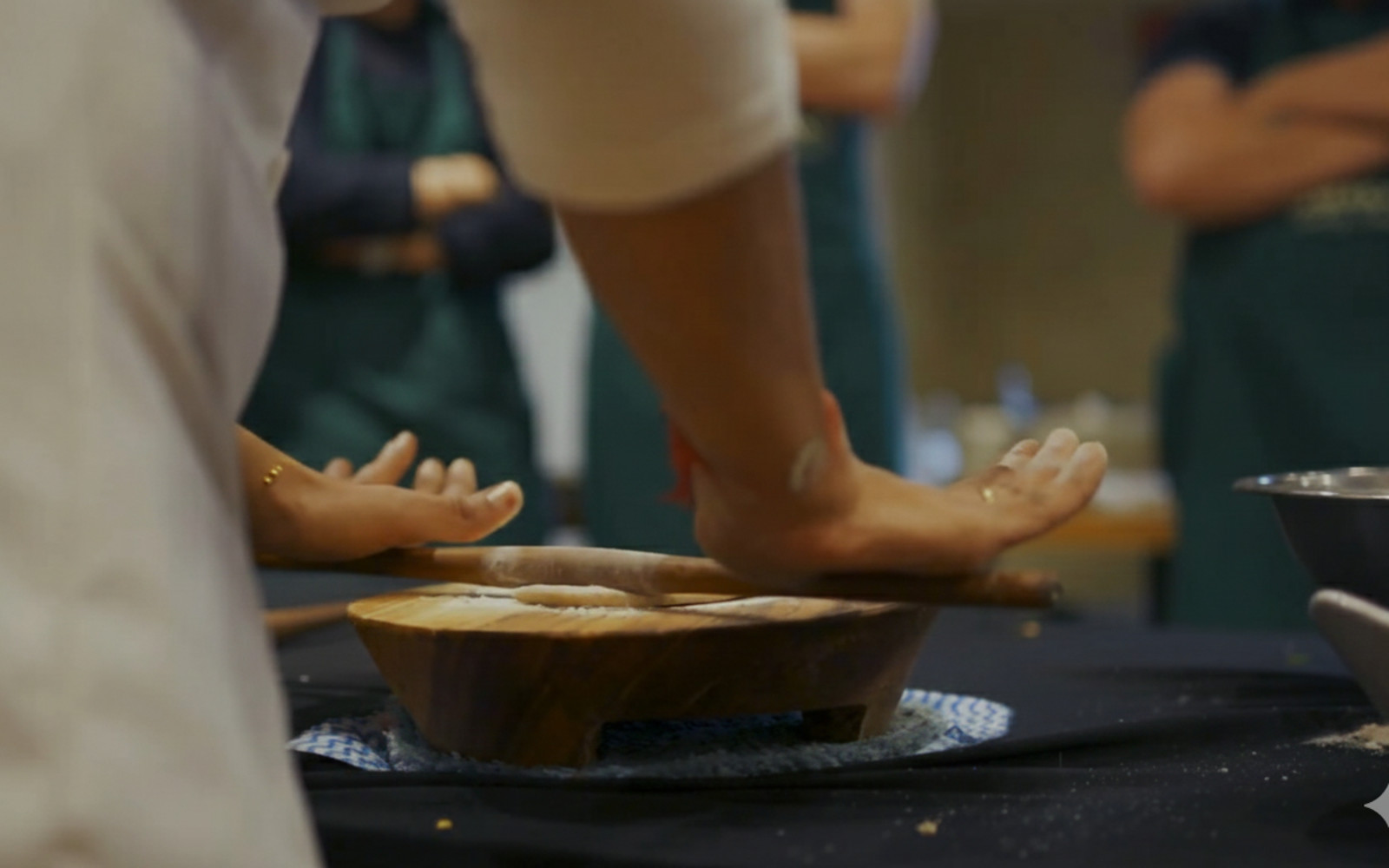
Every so often, Urmila teaches. Not formally, with a whiteboard and a lecture. She cooks, and people cook beside her, and somewhere in the doing of it, the knowledge moves in the only way it really can.
The classes have their own texture. There is always someone who is absolutely certain they cannot cook Indian food, who has tried before and found it chaotic, too many spices and too many steps. Urmila watches this person for a while. Then she says something very quiet and very specific, and the person tries again, and what they make is suddenly correct. Not perfect in the recipe-book sense. Correct in the way a thing is correct when it is done the way it should be done.
Last session, someone made the kadi on their third attempt and announced to the room that they would make this every Sunday for the rest of their life. Urmila said, without looking up from her own pan: then come back and we will teach you the dal.
She does not worry about teaching people to cook so well that they stop coming to the restaurant. As she sees it, teaching someone to carry the tradition forward is not competition. It is the point.
Our Cookery School runs across our Norwich, Cambridge, and London locations. Learn the recipes. Take them home. The kitchen that taught you will still be here when you want to come back.
We’ll have a table ready.
Book a Table