
Saturday mornings at Namaste Village begin before the restaurant does.
Not in the preparatory sense. Not the mise en place, the delivery check, or the linens. Those things are also true, but they are not first. What comes first, every Saturday, in every one of our six kitchens across Norwich, Cambridge, London, Twickenham, and Oxford, is something that most restaurant groups in England do not do and would find difficult to explain to an investor: the team gathers, and they chant.
Not as a performance or a wellness initiative or a team-building exercise designed by a consultant. In the sense of a genuine practice, carried by a genuine tradition, done because the people in that room believe that what they are about to do, cooking food for strangers, welcoming them as family, and holding a space that will matter to hundreds of guests, is worth beginning with intention rather than urgency.
The mantra meditation lasts perhaps twenty minutes. Sometimes a little more. The room is quiet in a way that a kitchen is almost never quiet. Then it ends, and the day begins, and the kitchen becomes what a kitchen should be.
What does prasad mean in cooking?
Everything, as it turns out.
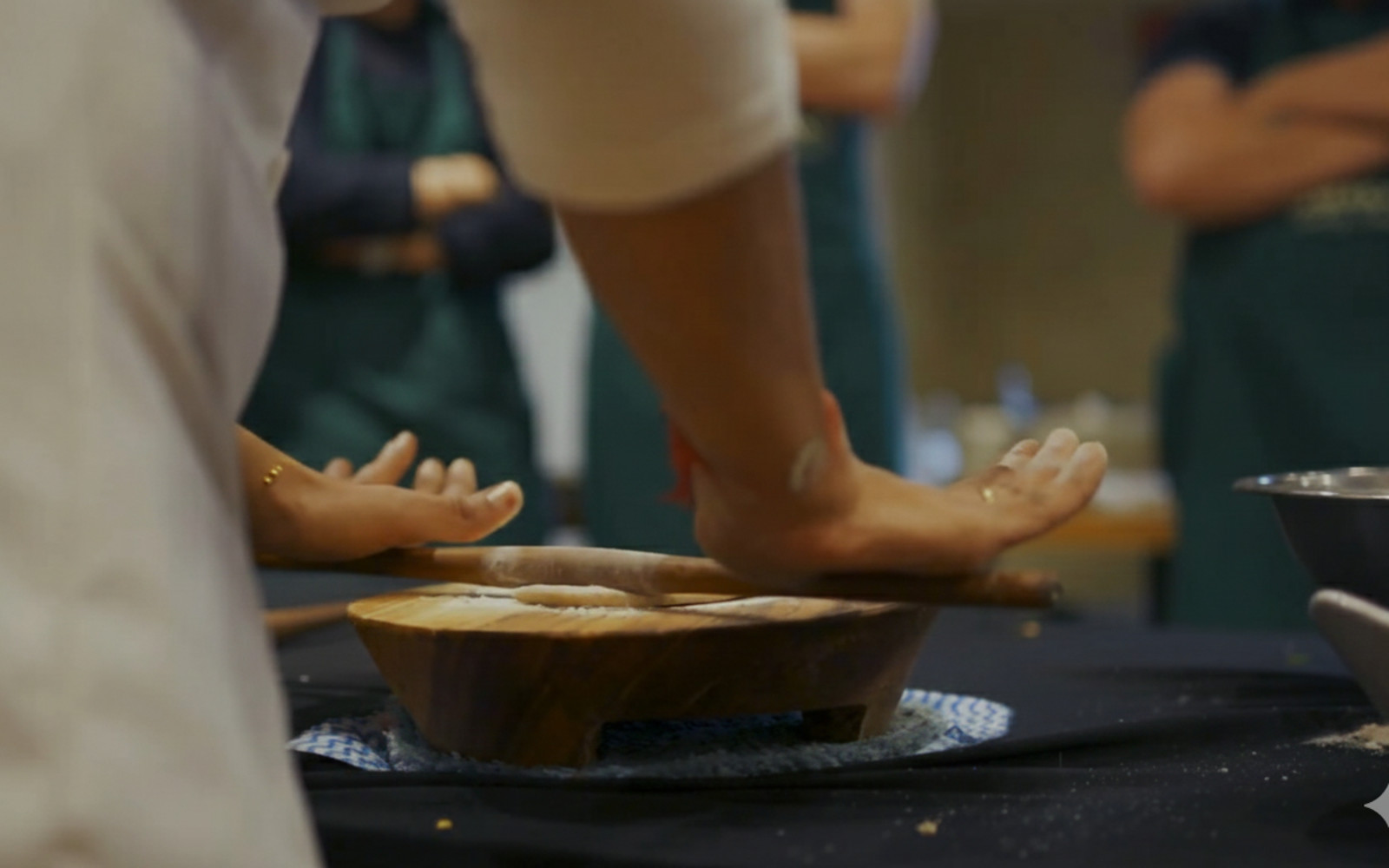
Urmila cooks the way she was taught to cook: as an offering. The Sanskrit word prasad describes food prepared with devotion, offered to the divine, and then shared as a blessing. It is the opposite of food made to specification or to margin. It is food made with the understanding that the person who receives it is worth the full attention of the person who made it.
Whether you believe in the theology behind this is entirely your own affair. What is not in doubt is the practice: the people who make this food begin every Saturday from a place of collective intention rather than collective anxiety. That is rare. The food tastes different because of it. Not magically, not in a way that can be measured in a laboratory. But genuinely, and noticeably, to anyone who has eaten here more than once.
What is satvik food and why does Namaste Village cook it?
Urmila's food is largely free of onion and garlic, and Ayurveda explains why this matters beyond the devotional tradition. In Ayurvedic terms, satvik food, which is pure, clean, and free of excessive stimulation, is connected to clarity and the kind of mental state from which good work, good relationships, and good decisions come. Urmila's kitchen is, in Ayurvedic terms, a satvik kitchen, not as a marketing position, but as the tradition it has always operated in.
The Saturday gathering is satvik in the same sense. It is not the absence of something. It is the presence of clarity.
What is the Dosa on the Wall?
There is a wall in Norwich, and in Cambridge, and in London, and in every one of our locations, where a dosa can be purchased by one person and eaten by another.
The Dosa on the Wall takes its inspiration from an old Italian tradition called caffe sospeso, the suspended coffee, a cup paid for but not collected, left waiting for the person who needs it and cannot pay. At Namaste Village, a guest can pay for a dosa for someone who cannot afford one. The dosa waits. The person who needs it comes in and asks. There is no form, no eligibility check, and no moment of public visibility that anyone should be asked to endure. Just the dosa, waiting.
This began because of what happens in those Saturday morning gatherings. Seva in Sanskrit means selfless service, giving without expectation of return. Atithi Devo Bhava means the guest is God, every guest, without condition. The Dosa on the Wall is what these principles look like when they step out of the kitchen and onto the wall. Making sure that the fight to survive is not also a fight with hunger. That is what we can do. We are doing it.
If you eat with us, you are already part of it. If you want to add a dosa to the wall on your next visit, ask the team. No fanfare. Just a dosa.
Come in on a Saturday. The food is always made with more care than you might expect. You now know a little of the reason why.
We’ll have a table ready.
Book a Table